Community Care, Mutual Aid & Resisting ICE in Minnesota
ICE has been terrorizing Minnesota, ripping families apart, and murdering people in the streets for two months now. Throughout that time, they’ve been likened to the Gestapo. And while there is no doubt they share terrifying similarities, as Lauren Jones notes, it’s critical to know that, “this is absolutely America, this is what America does, and what many of its citizens have voted for. From the first moment Europeans landed here, violence and subjugation has been core to the American project. Let’s be honest about this country, its history, and its commitment to advancing violence everywhere.”
Community Has Always Been Resistance
People of color have been under attack from this government since the beginning. And while many have the privilege of continuing to turn a blind eye, it does seem that more white folks have been forced to see the terror our tax dollars support. And that’s incredible. We need to unite against systems of oppression, not fight amongst ourselves. But if you are a white person, newly learning the true history and current reality of this country, it is not a person of color’s job to handle your crash-out.
The people in Minnesota have been keeping each other safe under government occupation. And just as government-led oppression of people of color is not new, this community response is also not new. Communities have been resisting and protecting each other against their own government since the creation of this country.
And Minneapolis has long been a site of resistance. The American Indian Movement (AIM) of the 60’s and 70’s was born in Minneapolis in response to police brutality against Indigenous peoples, “through the 1960s and 1970s, AIM patrollers scanned police radios and intervened during arrests in progress in an attempt to de-escalate a pattern of violence fomented by underinvestment, redlining, and intense policing.” And AIM communities are out again, protecting their neighbors. Anti-ICE organizing has reactivated and widened the systems of care, mutual aid, and rapid response that were created by AIM in response to the murder of George Floyd in 2020.
When you feel overwhelmed by what to do, know that there are hundreds of years of wisdom on how to resist. We don’t need to create new systems; we need to listen to the people who have been trying to create them. When we think of showing up in community or resistance work, patrolling and protesting often come to mind. Those are important, but not the only roles that need filling.
There are lots of ways to build, show up for, and be in community. It’s more than a weekend protest. Emobodying the fight for collective liberation means it’s more than an item on your to-do list. It’s everything. I guarantee, no matter your skillset, you have something to share in creating community and fighting for the collective. I love the list of potential roles created by David Gate, shared below.
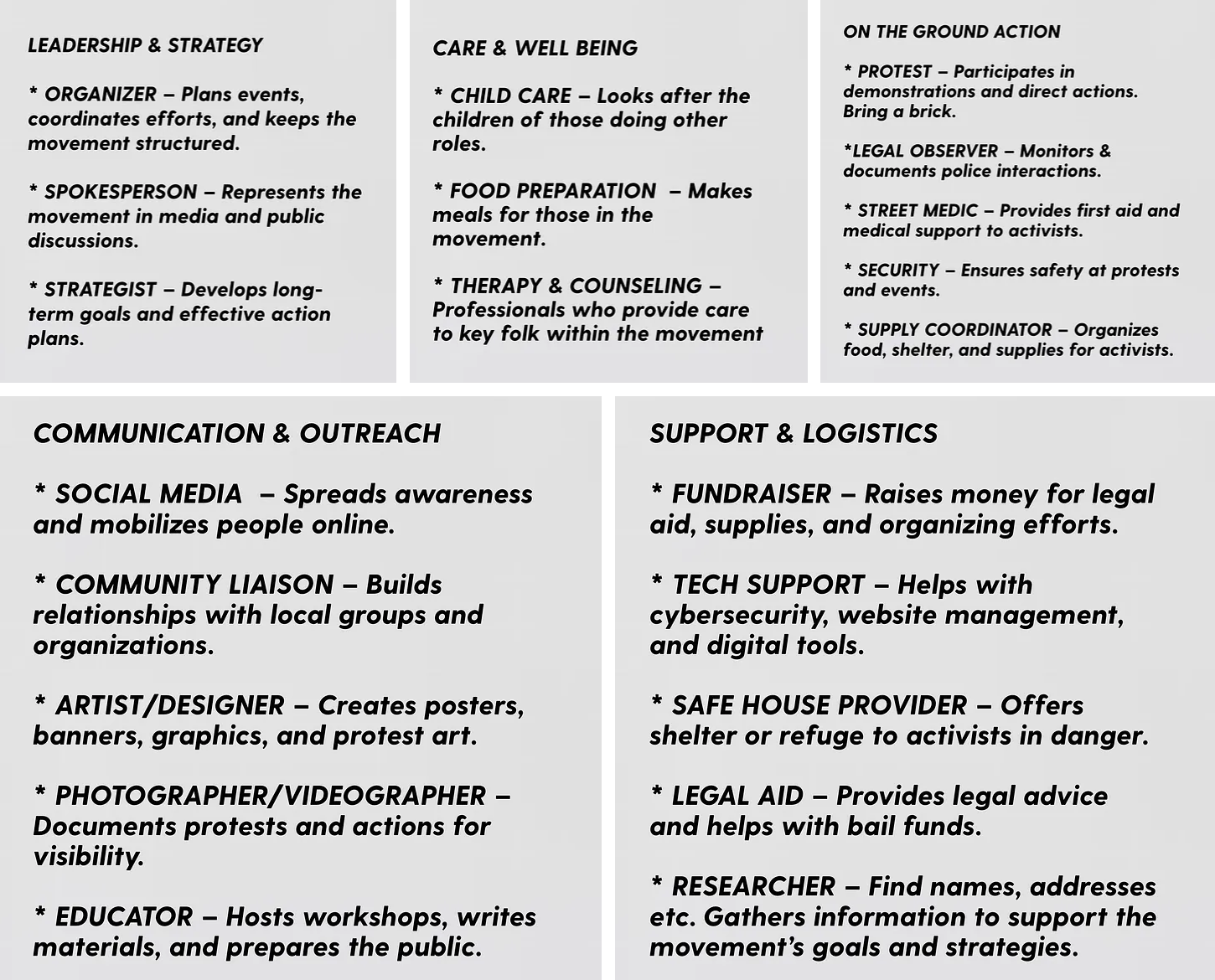
This list is not exhaustive, but it is a good reminder that showing up in community looks different for everybody and will change throughout different phases of your life.
Too often, we only highlight the rosy, shiny, fun parts of community, to which there are many, but don’t share about the messy stuff. Indeed, inconvenience and I’d say annoyance are a guaranteed trade-off. But if you think about it, that’s with any relationship. Community is a relationship, and turns out relationships take work and sacrifices.
Collective Liberation Requires Participation
You might find yourself at a meeting where everyone wants to talk over each other, it’s gone an hour over time, and you’re so hungry you can barely listen anymore. You might find yourself organizing in a room with an ex-partner, friend, or co-worker that makes you feel like your commitment to the movement is being tested by the universe. Totally inconvenient. Annoying af.
Amazon, Target, Home Depot, and Hilton Hotels have all been aiding and abetting the actions of ICE. Minnesotans have reminded us of the economic power people hold by boycotting and protesting these businesses. Yes, it’s inconvenient to change where you shop, but if that’s your biggest issue, you are doing alright, my friend. Boycotting billionaires is just another way of showing up for your neighbors.
You’ll also mess up. That’s part of relationships, too. Nike Aurea sums this up perfectly: “Community is not a collection of perfectly regulated people. It’s a collection of nervous systems, histories, projections, insecurities, socialization, and healing journeys. Sometimes you will be the one who caused harm. Sometimes you will be the one who was harmed. Community requires capacity for both roles.”
With those annoying, inconveniencing, uncomfortable parts come lots of juicy, lovely, hope-giving parts. The moments that remind you why the f*ck you’re even there in the first place. From creating a meal train for new parents to resisting when untrained racist goons with guns are let loose in your neighborhood - seeing your community stand up for those who need it the most and respond to each other’s needs with care makes it all worth it.
If you’re an introvert, you may be thinking this sounds good in theory but torturous in practice. I get it. It’s Winter time in Minnesota, which means it’s cold, dark, and sad. It’s easier to stay inside and stay isolated. I know the effort it can take to get out there, but it gets easier. And community isn’t just organizing and responding to a crisis. It’s knowing each other. It’s getting together just for funzies! It’s building trust. If you already know and trust each other, showing up in moments of crisis will be second nature. The foundation will be there.
Writer Susan Raffo shared a piece about the community she’s been experiencing in Minneapolis. This paragraph was too beautiful not to share:
There is a net and it has always been here, it is always here. This is not exceptional. There is nothing new here. All that is happening in Minnesota is that some of the confusion is fading and what is visible is the link and weave and stumble and steady between us. May we keep repairing it as it frays, from those outside and from the rising tension we hold within, and may this net grow with wisdom and may bodies tired of holding themselves up alone someday feel like they can relax into the steady certainty of something much bigger than the size of their skin.
Host a potluck. Start a book club. Run a game night. Onward we move together, growing our net. Do not let them steal this power from you and pacify you into forgetting that community is what keeps us alive. It always has.
Mutual Aid Is More Than a Crisis Response
Places to donate:
Resources for Organizing, Mutual Aid & Immigration Support
Movement Memos Podcast, episode, “Minneapolis Community Defense Is Riding on the Learning Edge of a Whirlwind.” This episode centers on Minnesota rapid response organizers, how to use social media in movements, mutual aid work, and more. A quote from episode I can’t stop thinking about came from Minneapolis organizer Andrew Fahlstrom: “We are becoming the people that we always knew that we needed to be.”
Better Future Podcast, episode, “Lessons From Resisting ICE - What Actually Works with Aru Shiney-Ajay.” In this episode, Aru shared the reality of what life in Minneapolis looks like under government, including stories of ICE following White folks with groceries, hoping they lead them to immigrant families in hiding. She also speaks to the importance of movement organizing in general and how to keep the momentum going.
“All My White Friends Are Crashing Out & I Don’t Know How To Feel” by Black Modern Mystic. The author speaks to the experience of realizing white people in her life were not listening before this moment, and are unraveling at the reality of the country. It calls for white folks to engage deeper with whiteness as a system of oppression. Important quote, “The future—if there is one worth building—will belong to those willing to give up whiteness, not manage it.”
This one is both for the learning and for the laughing. As I write this, Miles Bonsignore, host of the Perfect Person podcast, is wrapping up a 24-hour livestream fundraiser, raising money for the National Immigration Law Center. So far, he’s raised over $100,000, which is freaking incredible! Miles does a great job at using a comedic show to talk about serious things. My favorite content sweet spot.
